Vedic Astrology vs Western Astrology: 7 Key Differences You Should Know
Explore the key differences between Vedic and Western astrology, including zodiac signs, birth charts, Nakshatras, planetary periods, and which to follow.
Author - Shivani Sharma
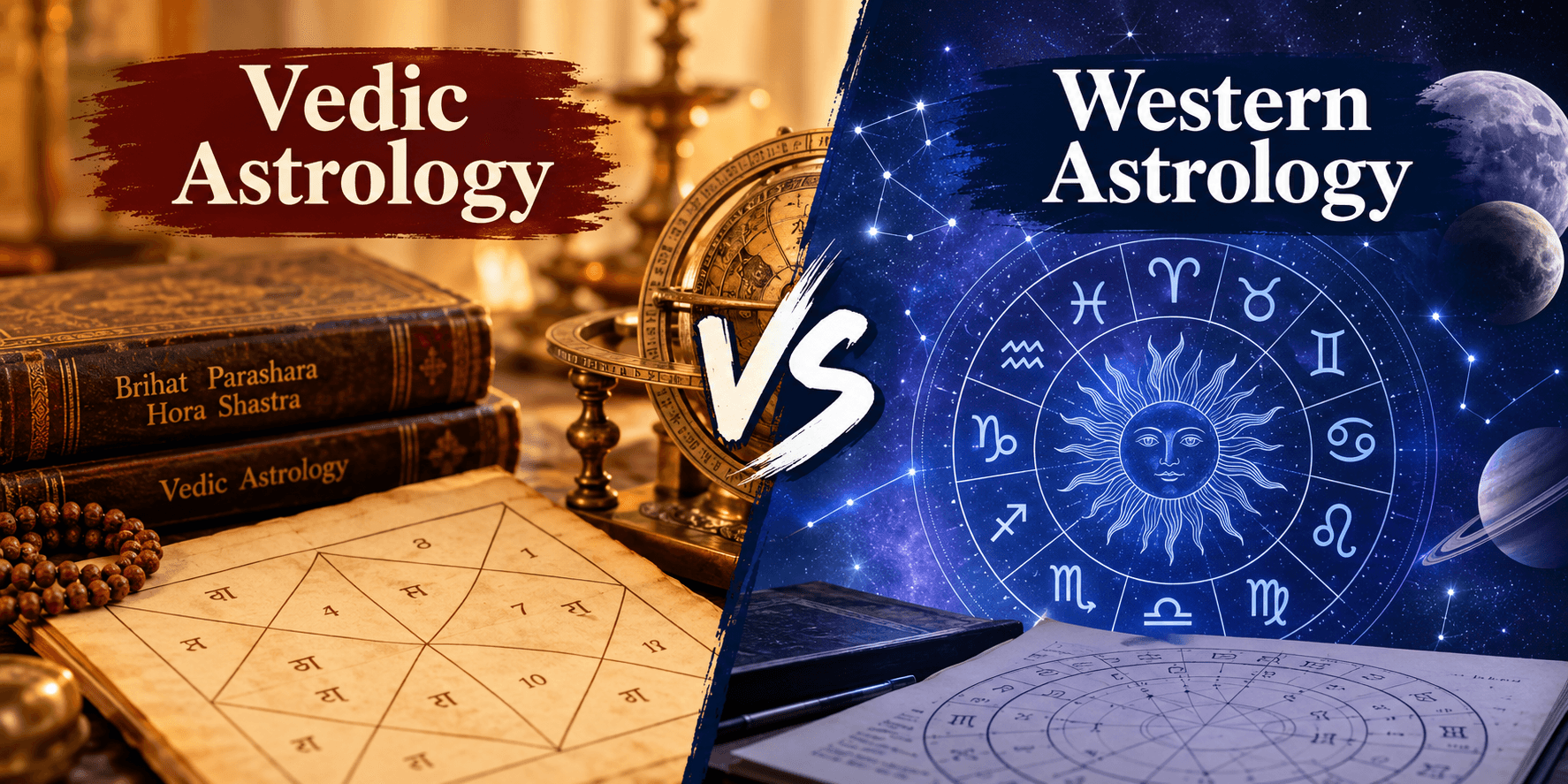
Introduction: Have you ever wondered Why Vedic astrology and Western astrology often provide different insights into the above questions?
Who are you?
How do your relationships work?
What does the future hold?
Vedic and Western astrology are interpreted differently as per their own set theories and approaches.
The Vedic Astrology is rooted in religious texts like “Brihat Parashara Hora Shastra (बृहत् पाराशर होरा शास्त्र)” which was authored by Maharishi Parashara. However, the Western astrology is founded on the writings of Claudius Ptolemy, the ancient Greek astrologer, and his book "Tetrabiblos." The texts give insights into zodiacs, horoscopes, planets, etc. Isn’t that interesting? Relax! You do not need to know anything about astrology to distinguish between these two forms of astrology.
At the end of this article you will understand what makes systems different in different parts of the world. So without further adieu, let’s find out…
Check This: Palm Reader Calculator
What Is Vedic Astrology?
Vedic astrology, also known as Jyotish Shastra or 'Jyotish Shastra,' is the ancient Indian system of studying the positions of celestial bodies such as planets and stars. Jyotish is studied in order to understand various circumstances of a person’s life, his or her past karma, current circumstances, and what does the future hold for him?
This period in Indian history dates back to around 1500-500 BCE. It was during this era that Vedic texts such as the Vedanga Jyotisha (attributed to the sage Lagadha) described how to calculate time and determine specific dates in order to schedule traditional rituals.
During thousands of years, the Vedic astrology has evolved and today it is studied and analyzed in birth charts of individuals. The great Maharishi Parashar is referred to as the Father of Vedic Astrology and his magnum opus, “Brihat Parashara Hora Shastra” is the most important text on Vedic Astrology. Other two sages Jaimini and Varahamihira have also greatly contributed in its development.
Vedic astrology is based on the sidereal zodiac, meaning that the signs and the position of planets in a birth chart are determined by their positions in relation to the stars. The birth chart in Vedic astrology consists of both the Sun sign and the Moon sign (Rashi), with more importance given to the Moon sign and the person’s mind, and the Nakshatras (27 major lunar mansions) in Vedic astrology. There is also much emphasis on the complete Janam Kundli.
Key concepts in Indian Vedic astrology include:
- Rashi: The 12 zodiac signs used in the chart.
- Nakshatras: The 27 principal lunar mansions.
- Positions of the Graha (Planets): Positions of the Sun, Moon, Mars, Mercury, Jupiter, Venus, Saturn and the lunar nodes Rahu and Ketu.
- Dasha system: Planetary periods used in traditional predictive astrology.
- Vimshottari Dasha: A widely used 120-year planetary-period cycle.
- Planetary Transits: This interprets the traditional influences of planets as they move through different sections of the chart.
Check out: Rahu & Ketu in Your Horoscope
What Is Western Astrology?
Western astrology is based on ancient Babylonian, Greek and Hellenistic methods, often combined in a mix and later evolved by individual approaches, like in the Yavanajataka (यवनजातक). Many forms of Western astrology focus on human personality, character traits related to emotional patterns and experiences, with a particular attention to human relationships.
A Western birth chart, commonly called a natal chart, has been drawn up using the time and place of a person’s birth and shows the position of the celestial bodies at that time.
Important elements include:
- Sun sign: These are the traditional symbols of personality and are often seen to define a person’s character and ways.
- Moon sign: Linking to the emotions and the needs of the person.
- The Ascendant or Rising Sign: Is how a person approaches life in the physical world. It is how a person normally present themselves to others.
- Houses in astrology: Represent different areas of life.
- Planetary aspects: Describe angular relationships between planets.
- Planetary transits: These are graphs of all the celestial events occurring over time and give us an insight into the changing themes of our life.
Western astrology commonly uses the tropical zodiac that connects the position of stars to the time of year, i.e. to the equinoxes. Many modern Western astrologers include in their models the traditional planets as well as Uranus, Neptune and Pluto.
Alan Leo (1860-1917), known as the ‘Father of Modern Astrology,' developed the field of astrology to focus on the individual’s personality and their full potential. He allowed people to use astrology in order to better understand themselves psychologically.
Vedic Astrology vs Western Astrology
There is a significant difference between Vedic and Western astrology in the methods used to create and analyze charts for people.
| Feature | Vedic Astrology | Western Astrology |
| Common zodiac system | Sidereal zodiac | Tropical zodiac |
| Birth Chart | Janam Kundli | Natal chart |
| Zodiac Calculation | Uses a sidereal reference and an ayanamsha | Anchored to the equinoxes |
| Lunar mansions | Nakshatras play an important role | Not central to most mainstream Western readings |
| Timing methods | Dashas, transits, and divisional charts | Transits, progressions, and solar returns |
| Common planetary framework | Nine grahas, including Rahu and Ketu | Commonly includes the Sun, Moon, and planets through Pluto |
These are broad differences, and there are many methods of practice within each of the two main schools of thought, and there are many variations within each of these.
See: 7 Reasons Why You Should Wear Firoza Stone for Benefits
Which One Should You Follow
Vedic or Western astrology?
It depends on what one wants to learn and not on any proven difference in predictive ability.
If you want to learn about Indian astrology or Vedic astrology, study Nakshatras, make a Janam Kundli, understand planetary periods, and read classical texts on Jyotisha, then choose Vedic astrology.
If you’re more interested in Western astrology, then learn about the tropical zodiac, how the planets are used in various aspects for the psychological parts of a person, various ‘modern’ methods used today for charting the personality of the individual, looking at current affairs and charting events in global circumstances for various phenomena currently happening.
If you are a beginner, start with one system, such as learning the basics of the Vedic astrology first. After this, you can compare the two systems and understand why some astrologers view things from a different perspective than others.
Conclusion
Vedic astrology and Western astrology offer two different approaches to understanding birth charts, zodiac signs, planetary positions, and life events. While Vedic astrology emphasizes the sidereal zodiac, Nakshatras, and the Dasha system, Western astrology commonly uses the tropical zodiac and focuses on personality, relationships, and self-reflection.
So, which astrology should you follow? Go for the culture you are interested in learning more about. Both can be subjects for a cultural study and for personal reflection—however, there is no proven scientific superiority of one over the other, so you can also test both, question both critically, and make up your own mind in the end.
In Summary, there is nothing wrong with making astrology a topic for analysis and introspection, although it must not be forgotten that there are other factors to consider.
Read Also: Palm Reading Marriage Line That Interpret Divorce and Separation
FAQs: Vedic Astrology vs Western Astrology
Q1. What is Vedic astrology?
Ans. Vedic astrology is an ancient Indian astrological system based on the sidereal zodiac, Nakshatras, and birth charts.
Q2. What is Western astrology?
Ans. Western astrology commonly uses the tropical zodiac to interpret personality, relationships, and life themes.
Q3. What is the main difference between Vedic and Western astrology?
Ans. Vedic astrology emphasizes Nakshatras and planetary periods, while Western astrology often focuses on personality and psychological insights.
Q4. Which is better: Vedic or Western astrology?
Ans. Neither has proven scientific superiority. Choose based on your interests and preferred approach.
Q5. Can I learn both Vedic and Western astrology?
Ans. Yes, you can learn both systems to understand their different methods and interpretations.
Know More:
- Shardiya Navratri 2026: Dates, Puja Muhurat & Ghatasthapana
- Kundli Milan for Marriage in 2026: Gun Milan Complete Guidance
- Moolank 3: Jupiter Connection, Personality, Career & Compatibility
- Dasha in Vedic Astrology: Meaning, Mahadasha, Antardasha & Effects
- Lal Kitab Astrology: Meaning, History, Remedies & Predictions
Recent Blogs
Vedic Astrology vs Western Astrology: 7 Key Differences You Should Know
Lal Kitab Astrology: Meaning, History, Remedies & Predictions
Navratri 2026: 9 Forms of Maa Durga and Their Astrological Significance
Dasha in Vedic Astrology: Meaning, Mahadasha, Antardasha & Effects
Shani Dev in Vedic Astrology: Career, Sade Sati & Saturn Remedies
Moolank 3: Jupiter Connection, Personality, Career & Compatibility